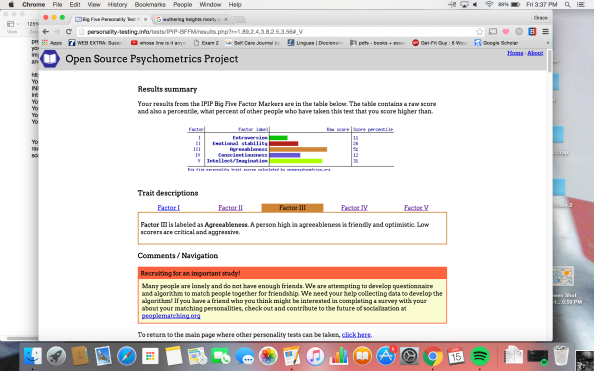
The first two personality tests, to me, seemed the most reliable, even though the second one was slightly irritating as for many questions I felt I was more in the middle than on any one side. They felt more reliable because they asked real, relevant questions, unlike the last test that simply had me click on colors and then tried to describe me based off my choice order. The third did seam credible and accurate at first, but their traits didn’t exactly line up with the Big 5, instead of openness, it rated me on intellect/imagination; I wouldn’t exactly say that openness and intellect/imagination are interchangeable terms. Also, the results are a little difficult to interpret. There is a bar graph and a percentage set in the results table, but the two do not line up, I got a 45 in extroversion and a 35 in agreeableness, but the bar for agreeableness is bigger than the bar for extroversion, which makes no since. I will say, however, that the first three do appear to be reliable, I was labeled ESTP by the first two and the third test described me fairly accurately, at least in my opinion. I feel that I really fit into the ESTP category very well. The first two seem pretty useful as far as I can tell. The third can help get somewhat of a reed on a person but shouldn’t be totally trusted. And the last test is just too far off base, it feels more like one of those dumb tests you would expect to find on facebook. In all, I feel like short, free online personality tests, like the for I just took, shouldn’t really be blatantly trusted all that much, if the test feels unreliable (like the color choice test) or if the results don’t sound like you, then the test is probably not that good.
Tag Archives: Spring 2016
Personality Quiz
Before I began taking the tests I was very skeptical about the results,and after completing the quizzes I stand firm with my assumption. First of all these tests seem very easy to smudge or cheat on. It wouldn’t be difficult to cheat the system, but even when someone like myself comes along and takes it as honestly as possible the results can still be skewed. The face validity on the majority of these quizzes was very high and it was very easy to see what the quiz was asking and what results certain answers would give. Oddly enough though the color quiz which has very low face validity was very accurate to a certain extent. I was very surprised that the quiz hit a lot of key points that i perceive about myself. Honestly I have no idea how the color quiz was accurate at these points, it really puzzles me, but I even enjoyed taking it the best compared to the others. The others were long and in an exam format that was fairly boring but I was very curious to see the results. Each of these quizzes gave about the same outcome comparatively. Each with their certain ways to calculate each factor of a personality, but it was something that seemed alright at face value even though their way to calculate personality isn’t really expanded on and is fairly generic. It is odd to see that the Color Test that I had the least faith in went the most in depth and was the most fun. Of course it did not get everything right in my opinion, but it covered certain aspects of myself that I truly feel and think about, even things that I am really uncomfortable with that I acknowledge. All in all it was a fun experience with an outcome that I could not have predicted, it makes me want to do a little more research into the Color Test and see how the results are made, as well as if there were other successes or if mine was just a fluke.
Sources for the Personality Quizzes:
http://www.humanmetrics.com/cgi-win/jtypes2.asp
http://www.personalitytest.net/cgi-bin/q.pl
http://personality-testing.info/tests/BIG5.php
Online Personality Tests
Before diving into these personality tests, I had already assumed that these tests would imprecisely describe my personality for the most part but touch on few traits that are actually a part of my personality. After taking the first test, I feel my presumption was accurate as I did not agree with a lot of they described as my personality moreover the career choices they suggested for me. A example of a statement I disagreed with is when a result stated that I could have a good career in teacher when actually I cannot tolerate a large amount of kids at one time or even a few of very misbehaved kids. I also felt that some questions I could not relate to enough so that may have influenced inaccurate descriptions. As of the other tests, they clashed with my presumption. Unlike like the first test the others, more than half of the time, created precise descriptions. It’s funny because while reading the descriptions I just had to smile because I would realize that at that moment that they described the type of person I am or would tend to do. I giggled a little when a result from one test stated that I enjoyed and found satisfaction in sexual activity because I really do. While reading the results of one of the last tests I felt that they may have bolstered my personality a little as I felt appreciated for traits that I kind of have noticed but was not absolutely sure that I showed that traits always. Still there was some inaccurate guessing about my personality but I highly doubt that any personality test is 100% accurate while still be specific and descriptive about several traits of a person. In all some credibility can be given to tests such as the ones I took however one needs to be careful of putting forth all trust and faith into these tests to provide them information of who exactly they are.
Sources for the Personality Tests
http://www.humanmetrics.com/cgi-win/jtypes2.asp http://www.personalitytest.net/cgi-bin/q.pl http://personality-testing.info/tests/BIG5.php http://colorquiz.com/
My Personality
Our personalities, while they’re something we live with, can sometimes surprise us when we are honest to ourselves and others about our wants and desires. These four personality test all asked similar questions about how someone feels in a social setting, how punctual someone is, the preference to go out or stay in, etc. A problem with these tests could be that people put what they want to do rather than what they actually do in a situation. Someone who strives to be social but is very much an introvert might put he/she would go out to a party instead of stay at home and watch a movie but when faced with the decision, they will stay in.
The first personality test I took was the Humanmetrics Jung Typology Test where I answered several questions as agree or disagree. My score was 16% introvert, 19% sensing, 41% feeling, 25% judging. These results surprised me a little bit because I assumed the introvert category would be bigger, especially according to my answers. I was also surprised to see how judgmental it labeled me because while I am judgmental in some situations, I hide it very well. The explanation of feeling which was my biggest category didn’t make me feel very comfortable because it makes me sound like all I do it go through life making every decision and responding to every situation by my feelings which I’m not sure I do. This test was semi accurate in some ways but the problem with the questions was sometimes I think I meant how I responded in a different way than they meant it when they asked the question.
The second test I took was the Personality Type Questionaire. My score on this test was surprising as well. I got the “Conservator” which is someone who is, “service and work oriented – very loyal. They are good nurses, teachers, secretaries, general practitioners, librarians, middle managers, and housekeepers. 6% of the total population.” I agree with these descriptions of me but I feel like I am more than these things. I am loyal to the people I trust and love and I love to do service but I also have fun and am not completely work oriented most of the time. This test seems to put people in very small boxes.
The next test I took was the Big Five Personality Test where I got some differing results from the last two tests. In this test, I got 9% extroversion which is the opposite of test #1. Maybe the questions in this test were worded in a way that I was okay with dealing with people. I got 11% emotional stability, 83% agreeableness, 46% conscientiousness, and 3% intellect/ imagination. Most of these I agree with.
The last test was the color quiz which I felt weird doing and I feel was the most inaccurate. On this quiz, I got results such as wanting to take control, emotionally unstable, emotionally detached, desire to win over people, manipulative, etc. All of these things are the opposite of what I got on the other tests and seem quite the opposite of how I feel and make decisions. I don’t this is test is very accurate at all.
Personality tests can’t cover every aspect and have many flaws in how the questions are asked and people being honest but they can at least give someone a doorway to start analyzing their own personality and in that sense, they can be quite useful.
I am First and Foremost a Scorpio
Color Quiz
I don’t think the color quiz was very accurate. Basing someone’s fears, desires, hopes, and unpleasantries purely based on the order of the colors picked isn’t incredibly scientific. I also kind of cheated: on the second go-around, the instructions explicitly said not to pick the colors in the same order as the first time, but I did it anyways, just to see if I could. I did it flawlessly. With that in mind, the quiz assessed some interesting items about me such as, “Feels unhappy and isolated because he is unable to succeed in finding the cooperation and understanding he desires,” “Tends to proceed with caution due to his fear of rejection. This attitude makes in difficult for him to earn respect or develop close relationships,” and “Is easily exhausted from too much argument and harsh circumstances. Sensitive and looks for sympathy and understanding from others.” Some of these check out because I have no emotional stability whatsoever, but one could apply most of those statements to a large population. That’s what I’m telling myself anyways.
The First Jungian Test
I received the INFP type. INFPs are rare and exotic with only 4% representation in the general population. I think I fit the type nicely: self-expressive, loner, misunderstood, impractical, hopeless romantic, the mediator of friends. This doesn’t describe my entire personality of course, but I think it’s a helpful tool when thinking about career paths and how I function in relationships. For me, I think this was the most reliable test.
The Second Jungian Test
The second test scored me as an INFJ, however, I only have a 1% difference between judging and perceiving. An INFJ is a lot like an INFP except INFJs aren’t as dreamy and are more of a perfectionist, spoken type. Both of these types are suppose to be the ones that change the world and make it a better place, so I’m fine with either of these. I think I fit more of the INFP description personally. I did like it provided percentages showing why you scored what you did, but I think that made me perceive the test as less reliable because I didn’t agree with some of them.
The Big-5 Test
These are my results from the test:

I scored the highest on agreeableness which is fairly accurate. I hate fights, debates, and heated arguments. Discussions are fine, but when things become argumentative, I shut down the conversation because I hate any kind of confrontation. I don’t know if I would say I’m practically friendly or optimistic though. I didn’t really score high on anything else. I honestly kind of expected that for emotional stability, conscientiousness, and extroversion. I’m not sure why the test-makers have intelligence/imagination as a category because that’s not in the Big 5 (in the description it does say it means open to experience, but that’s not the same as intelligence), and I’m assuming that the emotional stability is the same as neuroticism. The ad at the bottom for the social website also makes me suspicious of how accurate this test is because frankly, that friend matching website just sounds shady. I think the Big 5 traits are more difficult to calculate as well because people constantly improve or regress on those traits.
Getting to Know Myself
For the first two tests, I was labeled as an INTJ which is the same score I got doing the roommate selection thing. I’ve always been very interested in personality tests and scores so I have read a lot about INTJs and how they relate to the other personality types. I think it’s a pretty good description of who I am. What’s funny to me about it is that INTJs are described to be super confident but at the same time extremely self-conscience. I found a post once that portrayed it perfectly saying, “INTJ: I am perfect!… also INTJ: Everyone hates me and I also hate myself.” This was one of the most honest depictions I have ever seen, it captures the paradox that is the INTJ perfectly. Since I have received the same results on these two online tests as I have the real version, I think that they are pretty credible.
The third test I took was pretty accurate as well. I scored low on Extroversion and Agreeableness, very high on Conscientiousness and in the middle on Emotional Stability and Intellect/ Imagination. In my opinion, I think I’m a little more agreeable than the test makes me out to be but other than that it seems to have described me pretty well. As for credibility, I’m not quite sure where this test falls. It’s obviously not the real 5 factor test, but since it seemed to mostly describe me I would say that it is a partially credible source.
The last test, in my opinion, didn’t describe me well at all. I could be biased though because this test mostly said negative things about my personality and no-one ever really wants to hear about all of their flaws. The parts about failure, being distant and fear of commitment were kind of spot on though. This test doesn’t feel very credible to me at all. I don’t really see how the order of colors I chose can give that much insight to my personality and the results seemed a bit like they could be generalized to many people kind of like horoscopes are. But again, I could just be viewing this test in a negative way because it rubbed me wrong.
Week 11 Blog Prompt: Personality

We all want to know more about our ourselves, and psychological tests are one way to explore our personalities. While the full psychological tests are often long and require a fee to take, there are an abundance of free versions online. Take the four personality tests linked below, discuss how accurately they describe your perception of your personality, and discuss the credibility of each test. Make sure to use the tag “Personality” on your post.
- http://www.humanmetrics.com/cgi-win/jtypes2.asp
- http://www.personalitytest.net/cgi-bin/q.pl
- http://personality-testing.info/tests/BIG5.php
- http://colorquiz.com/
I look forward to seeing what you write!
Header image: CC by Flickr user Caitlinator
Orthorexia: Fact or Fiction?
After reading the proposed criteria I noticed some distinct withdrawals and effects from orthorexia nervosa that I believe are completely true however not everything within the criteria I deemed factual in some cases and not at all in others. Some of the statements made in criteria A seemed to have some exaggeration involved of just how people with this actually felt. Moreover I strongly disagree that severe weight loss is the result of malnutrition when relating it to orthorexia. I couldn’t help but acknowledge that there are potentially ties with this disorder and anorexia or bulimia nervosa. In all, eating healthy should not be considered an eating disorder because the boundary between eating healthy and having a mental disorder is not greatly set. I did not think my opinion however after reading the first article my it has slightly. It has convinced me a bit more that orthorexia could actually be a mental disorder when it gave an details on someone who has experienced such. It described the boundary between eating healthy and orthorexia more. In the second article, the possible origins of this disorder is discussed and how people could possibly develop this disorder followed by noticeable negative effects from the disorder. Similar to the first article, this one gives more insight of the disorder and its negative effects also mentioning the distinct differences between simply eating healthy and eating healthy to the point where it becomes unhealthy a.k.a orthorexia. On a final note while I had a big disbelief of orthorexia nervosa in the beginning, I now believe that it is an actual disorder that is trending within our society more than ever today and more people need to be aware of this disorder to prevent it from ever occurring to a friend, loved one, or even to themselves.
Sources
https://www.nationaleatingdisorders.org/orthorexia-nervosa
Orthorexia
I was shocked when I learned eating too healthy can be labeled a disease and unhealthy. Reading the criteria for orthorexia, I have both critical and positive comments. As I still do not understand how healthy eating can be excessive and a negative issue, the criteria does create a foundation for the topic to be explored more in-depth. It explains an emotional aspect (which I believe could be the only potential issue with obsessive healthy eating) as well as the dangers of cleanses and the obsession to reach and maintain a “fit” body. My critical comments mainly involve this: people can read this criteria and take away to stop eating too much healthy foods, before they get orthorexia. And that should not be the case at all. Especially with obesity being such a big issue in our country, the fear of orthorexia does not help.
Jacquelyn Ekern and Crystal Karges defined and described in better detail what orthorexia actually is. I did not get a complete concept from the first criteria, but this article gave me a better understanding. When they defined orthorexia, I was still skeptical about the seriousness of the disorder. They went on to explain it can lead to unhealthy dieting and cleansing. From watching other people experience this firsthand, excessive cleanses and programs can lead to lack of nutrition and unhealthy weight loss. Although weight loss is not necessarily the goal of people with orthorexia, it can definitely be an outcome to it. Symptoms of orthorexia include:
- “Elimination of entire food groups in attempt for a “clean” or “perfect” diet
- Severe anxiety regarding how food is prepared
- Avoidance of social events involving food for fear of being unable to comply with diet
- Thinking critically of others who do not follow strict diets
- Spending extreme amounts of time and money in meal planning and food choices
- Feelings of guilt or shame when unable to adhere to diet standards
- Feeling fulfilled or virtuous from eating “healthy” while losing interest in other activities once enjoyed.”
I found this article to be trustworthy. Credible references are cited, every piece of information is thoroughly explained, and the authors had a purpose to write this.
Dr. Karin Kartina provides origin and history about the term. Dr. Steven Bratman formed “orthorexia” in 1996, not as a diagnosis, but as a way to describe his health-obsessed patients. Usually someone with orthorexia is diagnosed based on health reasons, but other factors such as lack of safety from poor health, desire for complete control, desire to escape from fears, wanting to be thin, wanting to improve self-esteem, and using food to create an identity. Severe cases can involve social isolation because their lives are centered around food and planning for food. I found Dr. Kartina to be a credible source, as her schooling background would agree. Her information provided also came from credible sources.
At first, I was confused hearing about this disorder because what could be better than only wanting to eat healthy foods? But, the articles gave me perspective by adding in components such as diet plans, weight loss as a result, etc. Deciding if someone is just unhealthy or actually has a mental disorder is difficult. When symptoms like social isolation, weight loss, or any severe and potentially harmful things are involved, the person probably has the mental disorder.
Sources:
http://www.eatingdisorderhope.com/information/orthorexia-excessive-exercise/understand-orthorexia
https://www.nationaleatingdisorders.org/orthorexia-nervosa
Orthorexia: a Proper Disorder, or Just a Bunch of Medical Poppycock?
We all know of the two infamous eating disorders, Bulimia and Anorexia, however a third has been proposed, Orthorexia. Orthorexia is the unhealthy obsession of eating healthy. It sounds ridiculous, and some of the arguments do too, even one of its many traits was a tad comical, “moral judgment of others based on dietary choices” (Dunn, T.M & Bratman, S. 2016). This is that same as most fit-minded people or people who try to eat healthy. In fact, most people would judge a person who order 3 Big Macs at McDonalds for themselves. The way orthorexia is described by some puts it more in the light of just someone who’s stuck up about their strict diet:
They become consumed with what and how much to eat, and how to deal with “slip-ups.” An iron-clad will is needed to maintain this rigid eating style. Every day is a chance to eat right, be “good,” rise above others in dietary prowess, and self-punish if temptation wins (usually through stricter eating, fasts and exercise). Self-esteem becomes wrapped up in the purity of orthorexics’ diet and they sometimes feel superior to others, especially in regard to food intake. (Karin Kratina, PhD, RD, LD/N, n.d.)
To me this all sounds like the usual stuck up fitness nut or dieter. Descriptions like this make it look like doctors are just trying to label everything in life as some sort of disease or disorder. It’s the same as carcinogens, today it seems like everything will give you cancer, from a plastic water bottle to coffee. So really, orthorexia just looks like a bunch of crap produce by doctors trying to figure out everything about everything, for the most part
A lot of the diagnostic criterion look like they could lead to misdiagnosis, either that out they would only be able to diagnose severe cases. This is the other part, where the idea of orthorexia seems to hold some weight, orthorexia is the unhealthy obsession of “eating healthy”, meaning that a person would obsess over the food they eat, when they eat, how much, where it’s from, etc. and then having severe self-punishment or shame or worries when they go off diet. Other descriptions of orthorexia sound much more like a disorder than just a run-of-the-mill health nut who thinks they’re above everyone else, “Most of their life is spent planning and preparing meals and resisting temptation to the exclusion of other activities. They may even go to the extreme of avoiding certain people who do not share in their dietary beliefs or carry their own supply of food wherever they go” (Stefanie Lein, 2016). This describes an actual problem while the others sound more like people we could see in everyday life. The problem is that this source, an article posted on Eating Disorders Online, seems to have been written in response to other more credible articles, this one was more likely intended to explain what orthorexia is to curious people. The first two sources are much more credible. There were no ads on their websites, written by medical professionals, and give better and more details about the “disorder”, but like I said before, they just don’t sound right. Of course this could be a real thing that some people have, but I feel like most people who might be diagnosed with this (if it becomes an accepted medical disorder) wouldn’t actually have it but simply be picky eaters who are focused on eating healthy.