Changing your view on stress

Kelly McGonigal has been a health psychologist for 10 years which means she is most likely credible and knows what she’s talking about. Her ideas about tricking your body into believing stress is a good thing sounds easier said than done. When people say they’re stressed, it always a negative thing, it means they are going through a hard time, have to much on their mind or plate, etc. People always express sorrow when they hear someone is stressed, it’s a societal idea that stress is bad. It seems strange that just a simple adjustment of how we perceive our stress can change our health. I’m not sure how easy is it to take a moment when you’re stressed to tell your body that it’s a good thing when you know you don’t really believe that.

The other piece of information about oxytocin makes a little more sense to me. Everyone craves sympathy or supports when they feel stressed and it’s nice to hear that it’s a natural thing to want and can help your body cope with stress. It makes sense that telling someone about your stress can help while bottling it up hurts the person more. I always thought that was just psychological but it’s neat that it also effects people physically.

These two ideas seem easy enough to switch to in life. Next time you feel stressed, you can either tell someone about it or can treat it like a good, healthy challenge to have. I don’t think looking for stress just to do this would be wise but since most people experience relatively high stress often, it should be easy to find and implement in daily life. Whether tricking your body into believing stress is good works or not, maybe constantly telling yourself that will eventually trick you. Once your body react positively to stress, go tell someone your problems and you’re right as rain in the stress department, according to MGonigal.


Happiness is Happiness

Dr. Gilbert’s TED Talk about happiness and synthetic happiness was interesting, however, I feel like it’s an old topic. Everyone knows that money isn’t a guaranteed ticket to happiness, happiness comes from meaningfulness. The only thing that I found interesting was the synthetic happiness he was talking about. Personally, I’m not sure if I like the term synthetic happiness. If you feel happy, if you feel good, isn’t it real? Is there really a difference between when something makes you happy and when you just feel happy? I know the things that make me happy and I know it because I feel it. I’m happy when I enjoy a cup of the nice Colombian coffee my friend sends me, I’m happy when I feel the bass from my music in my chest, I’m happy when I hear the grumble of my V8 on the highway on ramps. Most of all I’m happy when I see my girlfriends face and here her voice on my phone even though we are separated by 861 miles. I argue that there is no synthetic happiness, there is just happiness. If something makes you happy, then it really doesn’t matter how. That’s not the only disagreement that I have, Dr. Gilbert spends some time on tests conducted at Harvard, the university he teaches at, and uses them as anchor points for his lecture. My issue here is that I just can’t accept everything he says here as this is his own work. Not only is there the possibility that he may try to make the experiment seem more important than it really is, but also he may himself believe that the experiment shows great and important results. When you make something yourself, you inherently see it in great light, and tend to miss the flaws. I would like to look more in depth at the projects Dr. Gilbert referenced to get a better understanding of the data and results.

I will say this, however, Dr. Gilbert’s point about being mindful in how we pursue happiness so that we don’t inherently destroy ourselves or hurt those around us is something I can agree with (for the most part, I do tend to speed a little, I like to go fast). We need to know what makes us really happy and what is just a cheap thrill (the difference to me being what does it every time and what needs to be bigger and better every time to work). If we pursue too much, we tend to lie, cheat, and be greedy, and that only leads to sorrow, not happiness.


The search for happiness has ended!

I really think Gilbert is on to something here. This TED talk gives me a lot of hope because the idea that we create our own happiness is kind of awesome. I’m not going to lie, until watching this video, I was one of the skeptics who believed that synthetic happiness isn’t the same as natural happiness. I’m only 19 but I feel like I’ve already spent a large portion of my life searching for that true happiness and, unfortunately, it seems like I could never quite achieve it. From the evidence he gave us though, I’m starting to see it from a different perspective. I always just assumed that when we don’t get what we want, we just settle and lie to ourselves that we’re happy with the end result and eventually just start to believe the lie, but it’s never really real. That’s why the studies Gilbert spoke of with the Monet prints were so surprising to me, especially the one with the amnesia patients. They literally believed that the print they didn’t know they owned was better than the one they first picked out of the set. Showing that their synthesized happiness of having a certain thing, turned into a real preference for it. The real lesson I took from this talk was, be happy with what you have even if at first you’re pretending to be…eventually, it will become real happiness. The fact that this is scientifically proven also makes it much easier for me to believe. Now that I have this little gem of knowledge, I’m going to start applying to my life anytime things don’t quite go my way by just telling myself that eventually I will be happy about this, I just need to give it time. I think Gilbert is pretty credible, not only does he have the endorsement of being on a TED talk, but he uses multiple studies and graphs to prove his point. We aren’t just relying on his word.  In his bio, it also says that he is a Harvard Psychologist researching happiness. To be frank, even if he wasn’t a very credible source, I would still like to believe what he has to say, because I think it will definitely help me in my life long search for happiness.


Extra Credit Blog Post

Since we ran out of time to watch the last video I wanted to show in class on Friday, I want to give you the opportunity to watch it and provide your thoughts. The video is from the ABC News program What Would You Do and aired in May, 2010.

After you watch the clip, write a post (must be at least 200 words and use the tag “Social Psychology”) sharing your reactions to what you saw, what you think you would do in this situation, and explain which of the following terms apply to this situation: stereotypes, prejudices, discrimination, oppression. The post is due at 9 pm on Wednesday, April 27th.


If you want to see the extended version of the clip, you can watch it here.

Week 12 Blog Prompts: Stress & Emotion

Hand writing on a notebook

Here are the two prompts for this week.

Option 1: Please use the tag “Emotion.”

We all want to enjoy life and seek ways to make ourselves happy. Indeed, we spend much of lives chasing the goal of happiness. But how good are we at actually finding it? Dan Gilbert discusses the ways in which we sabotage our own happiness in his TED talk. Watch the video, share your reactions, comment on the speaker’s credibility, discuss how reasonable you find its message to be, and discuss ways in which you can incorporate more synthetic happiness into your life.

Option 2: Please use the tag “Stress.”

Stress is something all too common in college students’ lives, but what if you could change your relationship with stress. Kelly McGonigal discusses doing just that in her TED talk “Making Stress Your Friend.” Watch the video, share your reactions, comment on the speaker’s credibility, discuss how reasonable you find its message to be, and discuss how you could implement some of the ideas into your life.

I look forward to seeing what you write!

Header image: CC by Flickr user Caitlinator


I’ve Got Personality!


FullSizeRender 7.jpgWe were asked to take four different free personality tests and compare the results to our personal perception of how we present ourselves.

Test One:

This test is a version of the Jung Typology, or MBTI, test where your personality is defi
ned
as four letters. Usually I’m an ENFP, but this test actually scored me an ENTP. According to the website, I would be a deviant kind of creative, overly ambitious in nature, loyal, debate-prone, and… entertaining at the very least. I think this is pretty accurate. At my core, I’m an artistic girl with a penchant for adventure and perverse humor. I take on too many projects, set my sights too high, and it usually ends in an Icarus-type scenario. Also according to the quiz, I should be fond of playing Devil’s advocate, which can be fondly remembered in my middle school self’s habit of “defending” Nazi Germany in world history class debates. Although I obviously didn’t sympathize with Hitler, it was extremely entertaining to go against the crowd in such a way. And, yeah, my friends say I’m an amusing human being.

I’ve seen a lot of these tests in my 18 years, and this one’s pretty standard: a gradient selection which allows you to pick degrees of an answer, a bunch of questions based on self judgement. The site’s also gotten pretty positive reviews from users who claim the results are reliable, and the information page is well researched as this is basically a sample of a for-sale product. I’d trust the credibility of the test.

While I’m not quite as optimistic as ENTPs tend to be, and I do have a strong introvert side, I’d score this quiz a solid 9/10.

Test Two:

The second test is another variation of the MBTI test. However, instead of ENFP or ENTP, I scored an ENTJ. Puzzled, I read the qualities listed and found myself not identifying with many. For instance, it propositions that I’m a very completion-oriented person who needs to be in charge and often grazes over either their own emotions or others. I’d only really agree that I prefer leading–but I’m also one hundred percent fine with following a leader so long as they’re competent… As for the other stuff, no. I am highly empathetic. I have a million projects going at once and have big problems getting anything in on time (lol). A look at my art desk will prove that.

I speculate that part of the reason for the inaccuracies have to do with the format of the quiz. As opposed to Test One, Test Two relied on a binary. You had one of two choices, not allowing for all the options desired. This probably led to the inaccuracy.

3/10.

Test Three:

What an interesting one! I feel as though I’ve taken this test before, but I didn’t have a clue as to what the results would be. This test rated you on a high-to-low scale in five “big” categories supposed to define your personality.
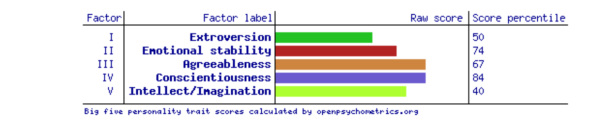
Screen Shot 2016-04-19 at 9.07.40 PM.pngAs you can see, I score high in extroversion, agreeableness, and intellect/imagination. I’d have to approve. In general, I’m an extroverted individual who has a natural disposition for maintaining friendships, and I’m always open to new experiences. The weirder the better, especially if I’ve got a friend by my side. Additionally, my low scorings in emotional stability and conscientiousness didn’t come as a surprise. I’m easily swayed by my moods, and I’m a disorganized mess. Didn’t really learn too much new.

The accuracy of this test probably stems from the gradient answer system which worked for me so well on the first test. It also cites Goldberg in the introduction.

8/10 because it’s kind of bare bones.

Test Four:

Another interesting one. This quiz had me randomly select colored squares based on intuition, wait a few minutes, and then redo the colored square selections. It’s then supposed to figure out your personality. Surprisingly, it was very accurate. It predicted that I’m an emotional, artistic person who lusts after beauty, intimate relationships, and who feels as though there’s more to the world than the present. I’m also prone to feeling isolated, can often be cornered into compromises, and have some difficulty appreciating the small things in life. It was really only erroneous in calling me a conceited person or that I easily become involved in pointless activities.

7/10.


Personality Tests

Humanmetrics Jung Typology Test

ENFP:

Extravert(16%)  INtuitive(12%)  Feeling(16%)  Perceiving(28%)

I have a slight preference of extroversion over introversion which is in some sense true because I don’t see myself as being the quiet one in the room that never says a word, but I wouldn’t consider myself to be a very outgoing loud engaged people person.  it says that ENFP’s are people persons and i can  disagree with that because i get socially awkward or shy around people I dont know. I also have a slight preference of intuition over sensing which i find to be very accurate because I’m usually with it most of the time and not confused about little things. In a workplace it says ENFP’s are creative and friendly which i can agree with as well. As far as the left over information about ENFP’s I say it’s not all of the reasons given are accurate to everyone and that this test really cant determine my personality. There are too many outside variables.

Personality Test:

My jungian  personality test is ENFP.. even though the acronym and classification is the same i personally think this test asked better questions, and the description about the personality seemed more accurate as well. This quote is a very good explanation of  the way ENFP’s are. “Their charming personalities can show signs of irritability and over-sensitivity when their desires to please different people come into conflict. During times of stress, ENFPs feel alienated. They then engage in deceptions that serve to obscure what is occurring within themselves.” I think this is very true about the way i feel when it comes to stress. But when stress grows internally this is not something I would do.. “may attribute malevolent schemes to others in order to explain away their fears.”


Big 5 personality test:

Extroversion (45)- I agree with being outgoing and social, most of the time.:)

Emotional stability(39)-I am opposite of having neuroticism and negative emotionality according to the big 5 I am emotional stable.. which could be argued against because I am not always emotionally stable.

Agreeableness(51)- Friendly, and optimistic. I am very friendly, not all the time optimistic, but I am shy so I’m usually friendly if somebody else starts a conversation first.

Conscientiousness(26)- I guess I am disorganized and impulsive because my impulse decisions are not always the best and I am usually late on things and not very organized.

Intellect/imagination(40)- I am imaginative and very open to new experiences.

I have to argue about the numbers because some are low and some high but I would argue that some need to be lower than others and some higher.

Color quiz:

The results on the color quiz I can agree with 100%. This quiz describes me as independent, striving for what I want even though stubborness is involved. EVEN though I have no idea the accuracy or credibility of this quiz i cant disagree with it because the way it described me in every aspect was on point and sounded like me!


Personality

Jung Typology Test:

For this test, my score was “INFJ”, slightly leaning towards introversion over extraversion, intuition over sensing, feeling over thinking, and judging over perceiving. I believe that in some ways, I seem more extraverted than introverted in some settings, but overall I do believe I am introverted. The rest of the scoring seems pretty accurate with exceptions at various parts of life. The test seems credible because there is no way that I could change my answers to fit a “normal, well-perceived” personality in society. Moreover, the questions are asking the same few questions over and over again with different wording to clearly assess what kind of personality you acquire.

Personality Test (2):

My Jungian personality was “INTJ”. I still believe that the test is credible because I was on the border with all four factors in the previous test. I know that I tend to think clearly about situations as well as follow my heart on some things, which is a clear indicator of why it was slightly leaning towards thinking in this test.

Big Five Personality:

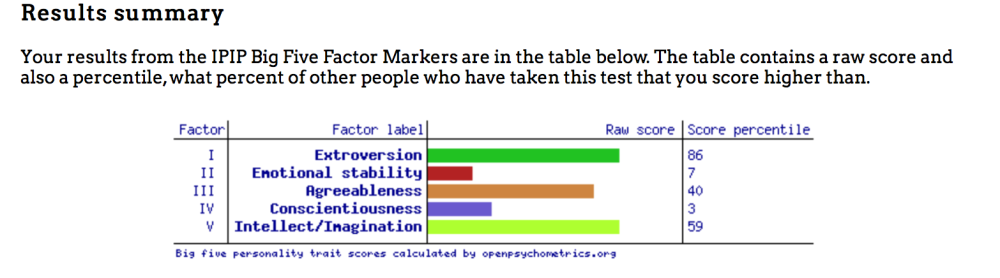
Screen Shot 2016-04-18 at 5.19.57 PM

I believe this test was very accurate on my overall personality. One thing I would slightly disagree with is that I am very open to new experiences, so I’m a little confused why I only got a 40 in the Intellect/Imagination. Other than that, all the other factors are pretty accurate of myself. I believe my extroversion was clearly conveyed in this test, because I have always believed that I am both an introvert, and extrovert. Overall, this test is credible in assessing various parts of personality.

Color Quiz:

The color quiz seemed very unreliable because it is solely based on the order you select colors. I also do not believe that I make “make irrational demands on others and refuse to compromise”. If anything, I’m the absolute opposite of that. The only accurate aspect of the test was my desired objective which stated that “Looking for affectionate, fulfilling, and friendly relationships.” I do not know, however, of anyone who would want a hateful friendship with anyone. All in all, I believe the color quiz was the least reliable of all the personality tests, and the big 5 personality test was the most reliable.


Do You Know Me Yet?

Test 1:

Humanmetrics Jung Typology Test™
ESFJ
Extravert(12%)  Sensing(12%)  Feeling(22%)  Judging(9%)
I found this test to be only slightly accurate to my personality type. The questions were accurate to predicting my personality, but they were redundant and too repetitive. Most were not in-depth and only offered the same questions. The results are hard to interpret, and although they are mostly similar to my type, they are still far off from what they could be.

Test 2:

INFJ “Author”

Strong drive and enjoyment to help others. These are serious students and workers who really want to contribute. They make good therapists, general practitioners, and ministers. 1% of the total population.

This test was more accurate to what I would consider my personality to be like, but it still did not feel as precise as I would have liked. The questions weren’t very detailed and didn’t give enough options for it to produce an accurate answer to each question. Sometimes I wanted to choose both or neither for a question but I was forced to pick one or the other.

Test 3:

This test allowed me to choose on a scale, which I found to be the most true to answering the various questions. It was easier to decide and I agree with my results to a point. I don’t find myself to be as extroverted as the test predicted me to be.

Color Test – Results

Your Existing Situation

Works well with others. Needs personal relationships which are understanding and relatively conflict-free.

Your Stress Sources

“Feels empty and isolated from others and wishes to overcome this feeling. Believes life has more to offer her than what she was experienced thus far, and doesn’t want to miss out on anything. she purses all her goals and dreams, fearful that any missed opportunity will cause her to miss out on even more. Quickly becomes an expert in any field she pursues and can sometimes come off as overbearing and nosy.”

Your Restrained Characteristics

Current events leave her feeling forced into compromise in order to avoid being cut off from affection or future cooperation.

Feels unhappy and isolated because she is unable to succeed in finding the cooperation and understanding she desires.

“Current situation makes her feel unable to prove himself, but tries to make the best of things.”

Open and emotionally involved in relationships and easily finds satisfaction through sexual activity.

Your Desired Objective

Very active imagination and may be prone to fantasies and daydreaming. Always dreaming of interesting and exciting things to happen to her. Is a charmer and wants to be admired for that.

Your Actual Problem

“Fears she will be held back from achieving things she really wants, leading her to search endlessly for satisfaction and become involved in activities which are pointless.”

Your Actual Problem #2

“Feeling held back and restricted from moving forward, looking for a solution that will give her more freedom and less obstacles.”

This test was surprisingly 100 percent true. I found it bizarre that a test that was so simple in design could produce such complex and accurate results. The color test was silly to take because I felt that I didn’t have to try, which may have brought out my true personality and have led to the most precise answers. This test demonstrates me completely, more than I thought I knew about myself. 


Personality

Humanmetrics Jung Typology Test

I think my results – which ended up being ESFJ – are pretty accurate. ESFJ means extroverted, sensing, feeling, and judging. Myself, as well as others who received the same result, are describe as “generous entertainers”. We also like to be in charge and we have no problem expressing our emotions, especially if we are upset. I do like to be in charge and I feel I am good and effective at resolving issues in the most rational way. The website describes ESFJ’s as caretakers and mothering. I feel like I do not completely act in that way, but I do care about others well being and I do have sympathy and empathy for others, I just would not say I am mothering. The most accurate part of the personality type is the extrovert aspect. I love to be around people, I love to keep busy, and I love to socialize.

“personalitytest.net”

Again, I was classified as an ESFJ. Since I figured the same result as the previous test would have a similar description, I looked into compatible careers on this site. I am currently in the education program, studying to be a high school English teacher and a basketball coach. All of the possible careers listed on the site all involved working with others, or serving others. I found it interesting athletic coach, elementary teacher, and special education teacher were listed, but not high school teacher. I think all types of teachers fit with the ESFJ personality type because they interact and help their students.

Big 5 Test

Factor 1: Extraversion- I scored on the 96th percentile for this factor. High scorers are outgoing and social.

Factor 2: Emotional Stability- I scored low, 36th percintile, on this factor. There’s not a long description for this factor, but I assume it means ability to control emotions. I agree with my low score on this because I easily become stressed, worried, or upset. I can easily let out my emotions and sometimes it is not in the best way.

Factor 3: Agreeableness- I scored on the 87th percentile, meaning I am friendly and and optimistic. This is accurate because I rarely have conflict with people, I have a wide variety of friends, and I am open to new things or people.

Factor 4: Conscientiousness- I scored only in the 36th percentile. Having a low score in this category means you are impulsive and disorganized. I know I am disorganized in the fact I leave my room and desk messy, but when it comes to organizing my school work and schedule I am good at that.

Factor 5: Intellect/Imagination- I scored on the 70th percentile on this category, meaning I am open to new experiences. People who score low are traditional and conservative. While I am definitely open to new things in every aspect, I do have traditions I stand strong with and my political views are completely conservative.

Color Quiz

I identified with some factors in my results, but for the most part I did not find this quiz accurate. My results said I am emotional and artistic and I need to be surrounded by beautiful things and art. I am not an artistic person whatsoever, and I find what most people consider “art” quite boring. It continues to say I need to meet people who have the same high value for themselves as I do, which is true, but then the results stated I still feel unfulfilled, which is not true. I am content with my current relationships with the people I associate with. The results said I am conceited and offended easily, again, not true. I am actually very critical of myself, but I do not necessarily care about outside negative thoughts people may have about me. The only other factor I actually identified with was I often feel stressed.

To conclude, the first three tests were accurate. They all had similar results in which I was able to identify with. As for the color quiz, I do not find it credible.